Product overview
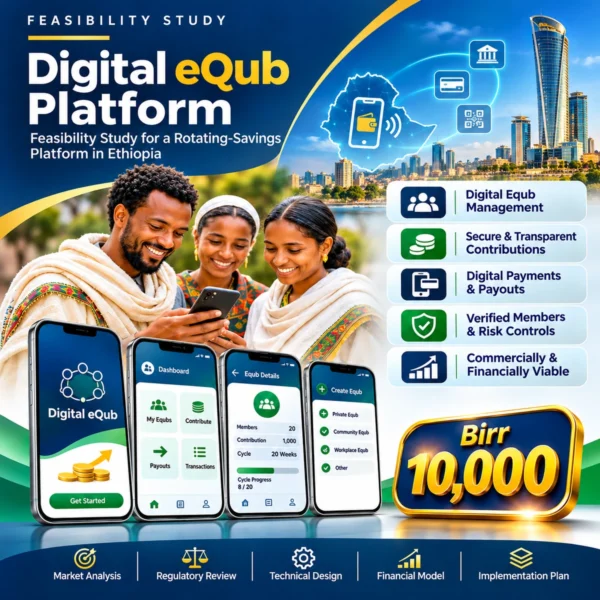
Equb is one of Ethiopia’s most widely used savings traditions. This study examines how a company could digitize Equb administration (onboarding, contribution schedules, payment records, payout ordering and default management) while leaving customer money with licensed banks and payment providers. It was prepared as a real project feasibility study in September 2026 for one Ethiopian launch market and has been anonymized, generalized to Ethiopia and professionally re-edited as a reference edition.
Main chapters
1. Executive summary
2. Project background and description
3. Market and demand assessment, including a bottom-up TAM/SAM/SOM method
4. Industry and competitive analysis of Ethiopian digital Equb platforms
5. Product and business model, with eight alternative models compared
6. Legal and regulatory feasibility (NBE perimeter, PII/PSO, KYC/AML, Fayda, data protection, tax, lottery-law questions)
7. Customer-fund, payment and settlement model
8. Trust, verification and risk-control framework
9. Software and technical specification (41 sections, functional requirements, acceptance criteria)
10. Operational plan and internal controls
11. Organization and detailed staffing plan
12. Marketing and market-entry strategy
13. Investment and cost requirements (ETB 12.40 million)
14. Financial feasibility: five-year projections, income statement, cash flow, balance sheet, break-even, NPV, IRR, ROI, payback, scenarios and sensitivity
15. Risk assessment and consolidated risk matrix
16. Detailed implementation plan with Gantt chart, decision gates and go-live checklist
17. Feasibility conclusion and recommendation; references; model-consistency annex
Key analytical components
▪ 48 numbered tables and 15 figures, including 4 investment and financial charts and 11 process and architecture diagrams
▪ Five-year base-case model: ETB 12.40 million investment, NPV of about ETB 17.45 million at 25%, IRR of about 54%, payback of about 2.9 years (project-specific assumptions)
▪ Conservative and optimistic scenarios and an 11-line one-variable sensitivity table
▪ Regulatory approval matrix and a list of 12 matters requiring formal NBE or legal confirmation
▪ Unit economics, break-even (about 4,700 active funded customers) and fund-segregation design
Practical applications
▪ A structural template for fintech, savings-group or payment-platform feasibility studies in Ethiopia
▪ A reference for regulatory questions a non-custodial platform needs to answer before engaging NBE
▪ A starting checklist for software requirements, payment integration and internal controls
▪ Teaching and research material on digital ROSCAs and financial inclusion
File formats
Editable Microsoft Word (.docx) and print-ready PDF, A4 portrait with landscape pages for wide tables. 83 pages including cover and front matter.
Important limitations
▪ The analysis was completed in September 2026 for a single regional launch market. Customer volumes, costs, staffing and timing come from that case and should be recalibrated for the market a buyer selects.
▪ Security, telecom and banking disruption reported in parts of northern Ethiopia from late September 2026 is noted in an Edition Notice; the analysis has not been revised for it.
▪ Financial figures are the original project’s assumptions and projections; they are not audited and are not market data.
▪ Competitor download and fee references reflect the September 2026 research cut-off.
▪ Known model inconsistencies (for example, the full staffing plan versus the lean payroll in the model) are disclosed in Annex A rather than corrected.
D. What’s included
File Description
Editable report (.docx) Full study, 17 chapters plus references and Annex A, with automatic contents and lists of tables and figures
Report (.pdf) Print-ready PDF of the same content, 83 pages
Front matter Publication information, post-study notice, disclaimer, contents, lists of tables and figures, abbreviations
E. Target customers
▪ Fintech entrepreneurs and startup founders in Ethiopia and the region
▪ Business and investment consultants preparing feasibility studies
▪ Investors, development-finance and impact-investment analysts
▪ Banks, microfinance institutions and payment providers exploring Equb partnerships
▪ Researchers and students in finance, development economics and financial inclusion
▪ NGOs and cooperative unions considering digital savings-group tools
▪ Software developers and product managers building savings or payment platforms






Reviews
There are no reviews yet.